
Crescendo (Ch 19)
Wherein a night of refinement and restraint fractures under the weight of public cruelty and private loyalty.

« previous chapter | start at the beginning | next chapter »
The story progressed rapidly as the opera’s first act unfurled, characters casting bold vocal lines into the theater like prophecy. But Harold’s attention was divided between the performance onstage and the one in the parterre box beside him. From time to time, he adjusted the controls on the remote. The plug in her tightened its rhythm. The soft internal buzz grew more insistent, then faded, then built again. The clamps on her nipples reminded her of every breath, every shift in posture. And through it all, she never once lost her poise.
Eva was flawless.
She blinked a little too often. Swallowed slowly. Crossed her ankles tighter than before. But she didn’t beg. She didn’t lean in to whisper a plea. She just sat and endured, her entire body a poem of obedience.
Halfway through the act, during a moment of applause, Harold leaned in again.
“You remember what to say if you’re close to climax?”
“Yes, Sir,” she whispered.
“Say it.”
“On the edge, Sir.”
“And if it’s getting too intense?”
“Yellow, Sir.”
“And if you need an immediate halt?”
“Red, Sir.”
He nodded. “Good girl.” Then he tapped the remote again and her thighs clenched anew. By the Act I finale she had edged twice, and each time he’d retreated.
The first time, she’d been almost grateful for the reprieve—public climaxing still unnerved her—but by the second, propriety had slipped its hold. She let out a soft, involuntary moan and lifted her hips in reflexive disappointment when both toys fell silent. The silver-haired patron ahead shot them a disapproving look; they returned it with matching masks of innocence.
Harold let a full minute pass—watching with quiet amusement as Eva clenched and relaxed in futile search of release—before he thumbed the plug back to its lowest setting.
As the lights went up for intermission, Harold leaned toward her, voice low and intimate.
“How are you doing?” he asked, his lips brushing the shell of her ear.
Eva turned her head slightly and murmured back, “Bottom half, green. Top half…reddish yellow.”
Harold nodded once, the faintest flicker of concern in his eyes. “Okay,” he said. “I’ll cover you—go ahead and remove them.”
A soft sigh escaped her lips, barely audible over the surrounding murmur of the theater. With a practiced motion, Harold shifted in his seat and opened his jacket wide, creating a discreet curtain with the dark wool. Eva dipped a hand beneath her neckline and pressed the quick-release. The clamps came off in a swift, silent motion, followed instantly by a sting that shot through her chest like heat from a match. Her breath caught, and she bit the inside of her lip to keep from making a sound. The returning blood burned and throbbed; it was almost unbearable for a few seconds before it ebbed into a pulsing ache. She passed them into Harold’s waiting hand and he slid them into the inner pocket of his jacket, the lining already warm from his body.
“Come on,” he said softly, standing and offering his hand. “Let’s stretch our legs.”
Eva took his hand, curious but trusting, and they slipped out of the parterre box into the thick current of patrons on the grand promenade.
“It’s been ages since I wandered the Met during intermission,” Eva said, her heels sinking softly into the red velvet pile.
“Then allow me to give you the unofficial tour,” Harold said, his tone wry. “No charge.”
He didn’t lead her toward the champagne bar or the outdoor terrace but down—through a less crowded corridor, then a set of velvet-lined stairs, until the hush of the lower level wrapped around them like a curtain.
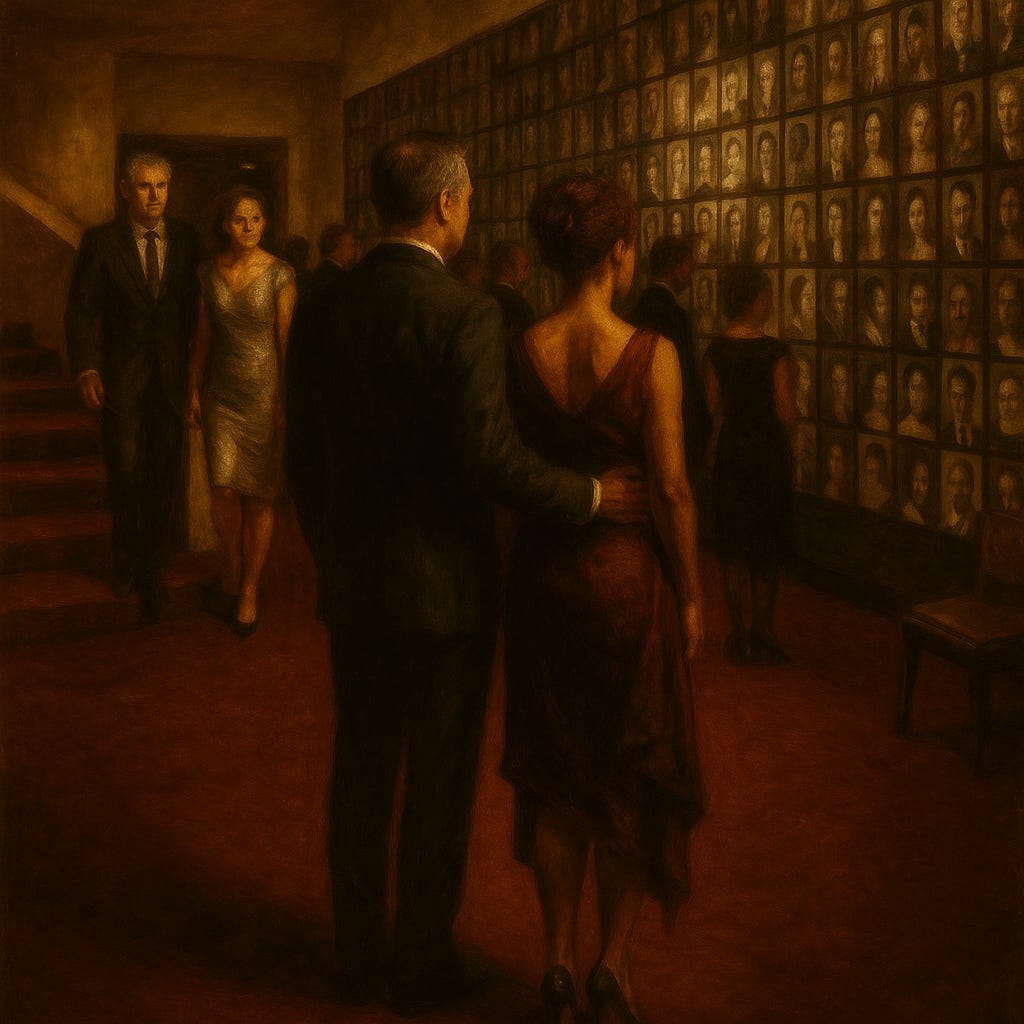
Ahead lay a long, curved wall covered in black-and-white photographs, a quiet pantheon of legends. Framed portraits, some serene, some mid-aria, watched silently over the hallway: Pavarotti, Tebaldi, Domingo, Price, DiDonato.
“This,” Harold said, gesturing toward one near the center, “is Corelli. Had the swagger of a prizefighter and the vocal punch to match. Over there—Del Monaco, another tenor who sang like the world was ending in every phrase.”
Eva followed his gaze, eyes lingering on the bold faces and familiar names.
He moved along, pointing as he spoke. “Leontyne Price; she was radiance incarnate. I could listen to her Aida a hundred times and never grow tired. Jessye Norman, majestic even in pianissimo. Anna Moffo, my favorite Violetta—in recordings, at least. She was before my time, unfortunately. Renee Fleming, marvelous spinning tone. DiDonato and Bartoli: brilliant technicians, endlessly expressive. And here,” he paused, “Dmitri Hvorostovsky…gone too soon.”
He saw Eva’s questioning look as he shook his head. “Brain cancer. I’ll never forget his last broadcast: he sang ‘Cortigiani’ from Rigoletto. His vocal decline was evident by then, but somehow it seemed fitting. One could imagine that—instead of fuming at the vile courtiers and begging for his daughter back—he was raging at the cancer that consumed him, and pleading for a few more good years.”
“My mother died of cancer,” Eva said suddenly.
Harold stopped mid-stride, brows lifting in surprise. “Eva—oh my god. I’m so sorry.”
She gave a small nod, eyes drifting somewhere past the corridor. “Metastatic breast cancer. I was barely a teenager. It hit me pretty hard.”
He didn’t try to respond with words—none would have been enough. Instead he took her hand, threading his fingers through hers with quiet certainty. His expression softened, concern etched in a way she had never seen from him before.
“I suppose,” she murmured, almost speaking to herself, “it’s part of why I never felt strongly about having children. I’d hate to waste away in front of my own child like that.”
Harold’s thumb pressed gently over her knuckles in silent acknowledgement. A promise of presence, nothing more.
“What about your father?” he asked softly.
“Still alive,” Eva said, “but with advanced dementia. He’s in a home out on Long Island.” She turned to him, offering a faint, melancholy smile. “And your parents?”
“Both gone,” Harold replied. “My father died of a heart attack in his late sixties. Mom sort of faded after that…had a stroke and passed away a few years later.”
Eva nodded, her gaze warm, receptive, as though absorbing a layer of him she hadn’t expected access to.
Harold exhaled, a dry huff of air. “Well. That got morbid astonishingly fast.”
Eva let out a small, nervous laugh and turned back toward the wall of portraits. “What about Callas?” she asked, gently returning them to safer territory. They looked up at the iconic image of Maria in profile, severe and luminous.
Harold tilted his head, thoughtful. “I’m ambivalent,” he admitted. “I love her in certain roles—Tosca, Medea—but in others, not so much. My college voice teacher saw her live when he was a teenager. Used to say that the real Callas was something the recordings only hint at, this collision of vocal color and presence so intense it bent the room around her. Magnetic. But fleeting.”
Eva turned to look at him, surprised. “Your voice teacher?”
He smiled. “There’s still so much we don’t know about each other, isn’t there?”
“You studied?” she asked.
“More than studied. I used to sing.”
“You mean…professionally?”
Harold nodded, just a hint of pride in his voice. “For a short time. Did a master’s in opera performance at Juilliard.”
Her jaw actually dropped. “And why has this never come up in conversation before?”
He shrugged, amused. “Didn’t seem relevant.”
Eva gave him a look. “Relevancy has nothing to do with it. This explains your singing in the garden, at Mark Twain’s house. This—makes you so much more interesting.”
He laughed, delighted. “Interesting enough to keep me around longer?”
Eva grinned. “That depends. Can you hit a high C and also cook pasta properly al dente?”
Harold gave a low laugh. “The pasta, no problem. The high C…well, that might require some surgical rearrangement of the family jewels. I’m a baritone.”
“Ah,” Eva said, nodding thoughtfully. “That explains the timbre of your voice in the mornings. Rich, deep, very grounding.”
He gave a modest dip of the head, acknowledging the compliment.
“So,” she asked, eyes flicking toward the portraits once more, “who’s your favorite baritone?”
Harold chuckled softly. “Actually, my favorite baritone of all time never set foot on the Met stage.”
“How is that possible?”
“Because he wasn’t known for opera,” Harold replied. “He was a lieder specialist. Dietrich Fischer-Dieskau. Absolute master of nuance. If you’ve never heard his Schubert, especially Schwanengesang, you’re in for a treat. Remind me and I’ll play Ständchen for you sometime.”
He slid one arm around her waist then, a gentle but deliberate gesture, and added, “What about you—any hidden talents I haven’t discovered yet?”
Eva tilted her head with a thoughtful look. “Well…I used to play violin, from childhood all the way through college. Then the moment I landed my first real job, I packed it up and quit.”
Harold lifted an eyebrow. “Were you any good?”
With breezy confidence, she said, “I once soloed the Mendelssohn violin concerto with my undergraduate orchestra.”
His eyes widened, impressed. “Very nice. You’ll have to play for me someday.”
“Only if you sing for me first,” she teased. “Classical singing, I mean—Sound Of Music doesn’t count.”
He pulled her slightly closer, his hand pressing gently at the small of her back as he met her gaze. “Perhaps that can be arranged,” he said softly, and then leaned in to kiss her cheek, the gesture tender, lingering just a breath longer than casual.
“Harold!”
He turned at the sound of his name, shoulders stiffening instantly. Eva followed his gaze. A man and woman were approaching from the base of the stairs, both in evening wear though their body language suggested anything but ease. The man had salt-and-pepper hair swept back with surgical precision and wore a navy dinner jacket over a pristine shirt. His smile was thin and bloodless, more of a signal than a greeting. The woman beside him held a flute of champagne with the practiced grace of someone born to cocktail hours and carefully veiled judgment. Her dress was a sheath of dark silver, her lips a shade too sharp for the occasion.
“Tom,” Harold said coolly, nodding once with brittle courtesy.
The other man returned the gesture with all the warmth of a business transaction gone stale.
“Didn’t expect to see you here,” Tom said, voice laced with something between sarcasm and suspicion. “Figured you’d stopped coming…given recent events.”
Harold didn’t blink. “No sense letting the season go to waste.”
Tom gave a hollow chuckle and swept his gaze past Harold—ignoring Eva entirely, as if she were a part of the scenery.
A pause languished between them. Harold was the one to break it, gently placing his hand at the small of Eva’s back.
“This is Eva,” he said, with intention.
Only then did Tom turn to her. His glance was cursory, polite in the barest sense. A nod, nothing more.
Eva met his eyes and smiled with quiet poise. “Pleasure to meet you.”
He gave her no reply.
“I didn’t think you’d be moving on so quickly,” Tom said, his eyes flicking back to Harold, voice low and needling.
The woman beside him stirred. “Tom…” she murmured, warningly. But her eyes remained fixed on Eva, tracing every detail—the cut of her dress, the pendant at her throat—with unhurried appraisal.
Harold’s hand tensed slightly at Eva’s back. His tone remained even.
“Sarah and I moved on years ago,” he said. “We’re just making it official now.”
Tom’s lip curled slightly. “It’s not official yet.”
“Perhaps not,” Harold said. “But it’s inevitable.”
The woman finally spoke, her voice as polished as her jewelry. “At least this one’s age appropriate.”
Tom gave a quiet, approving chuckle. “Appropriate in other ways, too.”
The two of them shared a tiny, conspiratorial look. Their expressions were impeccable, but something in the moment felt coded, pregnant with unspoken implication that settled in the air like a faint toxin.
Harold turned stiffly to the woman. “Meredith.”
She didn’t acknowledge the greeting. Her gaze flicked to Eva once more, continuing to appraise her in the lobby’s golden light.
“Don’t let the fancy watch fool you, dear,” Meredith said, sipping her champagne with a slow swirl. “Harold’s generosity is rather self-contained. I wouldn’t expect much to spill over.”
Eva blinked, caught between offense and disbelief. She opened her mouth—but Harold spoke first.
“Coming from you,” he said quietly, “that’s rather ironic.”
Tom’s expression hardened at the slight against his wife. “Do you have any idea how much Sarah sacrificed for you?”
“There were sacrifices made on both sides,” Harold replied evenly, unwilling to cede ground.
Tom scoffed. “You’ve always been so full of yourself. Thinking you’re the smartest person in the room, and that entitles you to do whatever the hell you want.”
Harold gave a half-smile. “Well. At least I’m consistent.”
Eva was shocked at how quickly the gloves had come off. Her body went rigid in that familiar, bracing way that sensed danger lurking, though she felt no real threat.
“She could have done so much better than you,” Tom said frigidly.
Harold’s expression remained composed, but his tone sharpened just slightly. “I’ve thought that myself more than once. At least then I’d have been spared moments like this.”
Meredith gave a brittle little laugh. “I hope she takes you for everything you’ve got.”
Harold exhaled slowly, his voice turning pensive. “That’s what you two simply can’t understand. It was never about the money.” He shook his head condescendingly. “People like you never understand.”
Tom inhaled sharply, his eyes narrowing. “Enjoy your evening,” Tom said coolly. “And best of luck convincing this one to stick around.”
Harold’s body snapped taut like a wire pulled too tight. His jaw flexed once, twice, violence simmering under his skin.
“Come,” he said to Eva, quiet and barely controlled. “We’re going back to our seats.”
She nodded out of instinct, unable to hide a tick at the corner of her mouth as he guided her past Tom and Meredith towards the carpeted stairs. Eva kept her eyes down, eager to escape the couple’s presence, but Tom’s voice drifted outward, low and venomous—words meant only for his wife, but whispered just a hair too loudly.
“…looks so pathetic with that dusky whore.”
The words slammed into Eva. She froze, a cold wash rolling over her skin like a plunge into ice water. Harold didn’t freeze so much as detonate. His reaction came before Eva could even inhale.
In one clean, unhesitating arc, he spun around and connected his fist with Tom’s face.
The impact cracked through the air, ugly in its finality. Tom’s head snapped back. He collapsed onto the carpeted floor with a guttural sound, his hand flying to his cheek as blood bloomed at the corner of his mouth. Meredith gasped and stumbled backward, her shawl slipping from her shoulders as she tried to shield her husband without getting too close.
Harold stood over him, chest heaving, eyes blazing far past anger, radiating something ancient, territorial, and perilously close to uncontrollable. His fists were still clenched, arms vibrating with the sheer force of emotion barely held at bay.
Eva couldn’t move. Her feet were anchored to the floor, shock rippling through her body in slow, numbing waves. She had never seen Harold like this, stripped of every layer of gentleness and restraint, standing wholly in the aftermath of a line he hadn’t even realized he’d crossed until it was well behind him.
“You can drag my reputation through the mud if it pleases you, Tom. But say another word about her, and I promise you’ll regret it.”
Tom spat blood, the dark smear doing its best to blend in with the floor. Meredith gasped and dropped to her knees beside him, fumbling for his sleeve to help him upright. He wiped his mouth with the back of his hand, eyes blazing.
“Is that a threat?” he rasped, breath shaking with fury.
“Absolutely,” Harold said, voice like a blade.
Eva broke free of the shock that had rooted her in place. She rushed to Harold’s side, fingers catching his arm.
“No—no, it’s not,” she said quickly, her voice breaking with urgency. Then, lower, fiercely directed only at him: “Harold, we need to go.”
But Harold wasn’t done. He shook her off with a rough twist of his shoulder and leaned toward Tom again, words crackling with years of restrained venom.
“I can take your poison,” he said, each syllable tight. “I’ve taken it for years. But you will leave her out of it, or I swear—”
“Sir, step back.”
Security materialized out of nowhere—two guards first, then a third. The sudden insertion of bodies forced Harold away from Tom, who clutched Meredith’s shoulder as he struggled upright with staff assistance.
Harold tried to push past the guards, fury still burning off him in waves. “Don’t touch me,” he snapped, voice rising as they blocked his path. “I said don’t—”
“Sir, that’s enough,” the largest guard said firmly.
Eva hovered at the edge of the action, anxiety clawing up her spine, her hands trembling. She searched for any opening where she could reach him without being swallowed by the chaos.
Across the way, Tom held a cloth to his split lip while a member of the Met staff crouched beside him. Meredith’s eyes lifted and found Eva’s. The contempt in them was immediate and unfiltered, an accusation sharpened to a point.
The look hit Eva like a slap, but by now she’d had enough. She stared back, refusing to flinch, even as her stomach tied itself into knots. She didn’t know what she’d done to earn that kind of hatred, and the not-knowing landed harder than the glare itself.
At last, Meredith broke their locked gaze, turning back toward her husband as he attempted to stand.
A Met staff member—a younger woman in a black blazer—approached Eva, voice polite but strained.
“Ma’am…are you with the gentleman over there?” She nodded toward Harold, still caged by security.
Eva swallowed. “Yes.”
“I’m very sorry, but we’re going to have to ask both of you to leave the theater.”
Humiliation swept through her, hot and immediate. Still, she managed a tiny nod. “I understand.”
She crossed to Harold, pushing past a guard’s shoulder. “Harold,” she murmured, touching his arm.
He turned toward her sharply with wild eyes, breath heaving. But when he saw her, something shifted, like a tether pulled taut.
The guards stepped in again. “Sir. Please.”
One reached out and placed a firm hand on Harold’s arm.
Harold jerked away. “Get off me.” His voice bit the air. Then, through gritted teeth, “Fine. We’re going.”
The guards stayed close but gave them space, escorting without touching again. Together they walked toward the grand exit, his stride clipped with anger, hers tight with mortification. Conversations hushed as they passed. Eyes followed. The red-and-gold splendor of the lobby seemed suddenly hostile and accusatory.
Behind them, the guards kept a polite but unmistakably vigilant distance. Eva’s cheeks burned. Harold’s jaw flexed with every step, the fury radiating off him in waves.
They crossed the threshold into the brisk night, and only then did Eva breathe freely again.
A tangled web continues to be woven. The twists and turns and, where are we going next, I wonder. Surprised by the explosive end, now I wait for the story to continue to unfold. Loved it, Demetria!
Ahhh Demetria! What happens now, what are we going to learn about Harold?