
Composition (Ch 5)
Wherein an evening at the Guggenheim becomes confession: two souls collide between abstraction and truth, and art witnesses the unraveling of restraint.

« previous chapter | next chapter »
This chapter is inspired by a retrospective of my father’s favorite artist at the Guggenheim several years ago. He didn’t live long enough to see it, so I visited in his honor and took a selfie in front of his favorite painting.
Dellen spotted her before she saw him.
She was standing near the base of the Guggenheim’s sweeping spiral, its white façade glowing softly in the fading blue of evening. Streetlights threw long reflections across the pavement, and the museum’s interior glow spilled over her shoulders like an invitation. He approached with an easy smile, gloves folded loosely in one hand—two figures drawn by the same light, converging on the museum’s quiet promise.
“Darling Lys,” he called, voice rich with pleasure. “You must be very excited to have out-arrived the early arriver.”
She turned with a playful shrug, her smile blossoming. “I was already in the neighborhood…but yes, I may have gently manipulated geography in my favor.”
He laughed. “I’m thrilled to show you this.”
“Are you kidding? I’m the one who’s thrilled. I’ve adored Kandinsky since I was a teenager. How did you even manage this? I thought his works weren’t on display right now.”
“They aren’t,” he said. “Except for a private exhibit this weekend for foundation donors.”
She narrowed her eyes. “And you blackmailed the board into an early peek?”
Dellen’s expression was grave. “Sometimes you just have to grease the right cock.”
She blinked. “Excuse me?”
His grin broke through. “You really couldn’t tell I was joking?”
She smacked his shoulder, laughing. “Never say that with a straight face again.”
“Where’s the fun in that?” he said, pleased.
Her smile lingered as they turned to the entrance. Dellen opened the door with a quiet flourish. Lys stepped inside, boot soles soft on polished stone as they approached the curved check-in desk where a staffer waited.
“Evening,” Dellen said politely. “We should be on the list for the Lincoln Foundation Patron Preview.”
The staffer nodded. “May I see your IDs?”
They handed over their cards. The staffer typed briefly, eyes flicking between screen and IDs.
Then he smiled. “Ms. Delaney, Mr. Beckett—welcome. You have 45 minutes before the next group arrives. Please follow me.”
He stepped from behind the desk and led them down a roped-off corridor. The Guggenheim’s dramatic spiral and rotundas gave way to a quieter space: a short hallway ending in a black velvet curtain.
He pulled it aside, revealing a long rectangular gallery.
The space was elegant in its restraint: high ceilings, matte black walls, and subtle track lighting that spotlighted each canvas like a precious object. The hum of the city faded; in here, it was just them and the art.
Lys drew a slow breath.
Dellen leaned in, voice low. “I hope you’re ready.”
She didn’t answer right away. Her eyes were already scanning the room, alight with wonder.
“Oh, Dellen,” she murmured. “I’ve been ready for this since I was sixteen.”
They paused before the first painting on the left, as the discreet placard at the entrance had gently suggested: a clockwise circuit, unhurried. This piece wasn’t Kandinsky’s. Instead, it was a portrait of the artist himself.
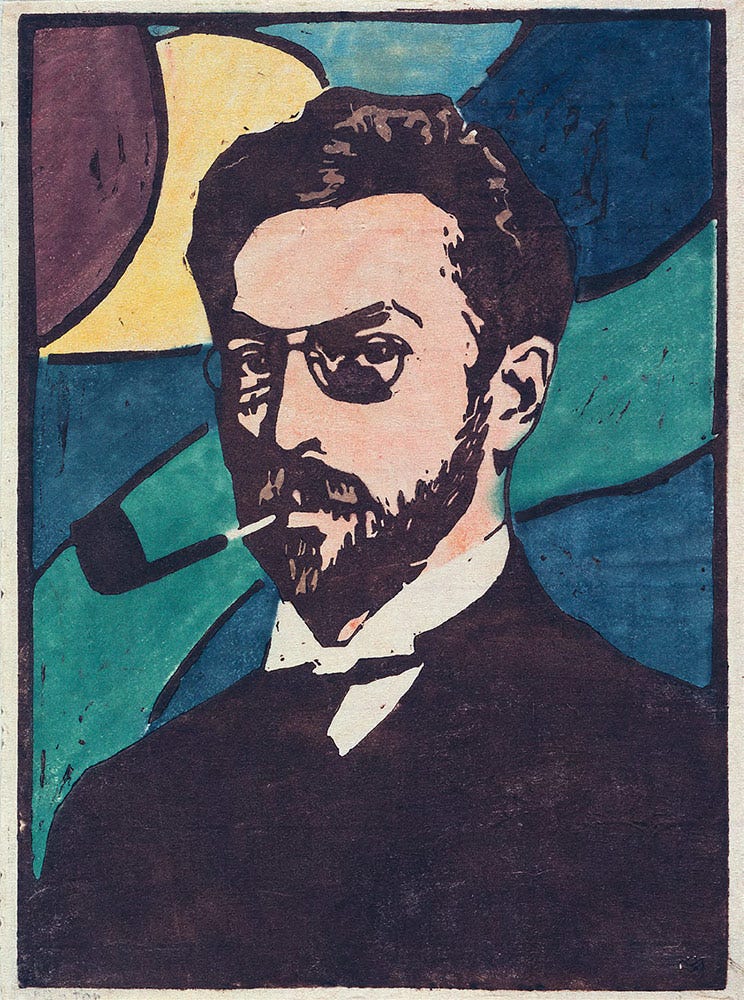
Dellen leaned in slightly, scanning the plaque. “Gabrielle Münter,” he said. “His partner for a time, and an artist in her own right. They worked closely for years.”
Lys gave a small nod, eyes narrowing on the portrait. “Of course her painting’s here because it depicts him.” Her tone was dry. “A woman’s work made notable by proximity to a more famous man. Quelle surprise.”
Dellen hummed thoughtfully, studying the brushwork. “Maybe you should take up painting,” he said, glancing sidelong. “I can quietly steal your ideas and pass them off as my own.”
Lys arched a brow. “And if I turn out to be a talentless hack?”
He turned to her, mock-serious. “Then I’ll simply tell the truth: the canvas bears the unmistakable mark of a woman’s touch.”
She faced him, eyes narrowed with suspicion tinged in fondness. “You’re particularly feisty tonight,” she said. “What gives?”
He just smiled, the corners of his mouth curling with mischief. “I’m simply happy to be spending time with my favorite submissive.”
“Even though we’re not in scene?” she prodded.
He strolled toward the next painting, graceful and unhurried. “Oh, dearest Lys,” he said over his shoulder, velvet-voiced, “wherever you go, the scene always follows.”
She lingered, watching the ease in his step, the casual confidence. Something was different tonight. Not just charm or playfulness—something deeper, though she couldn’t quite place it.
They moved slowly down the gallery, the hush inviting a kind of reverence. The next canvas—Fishing Boats, Sestri, 1905—was a seascape in slashes of lavender, teal, navy, and green. The water shimmered with iridescence; the boats floated in as if summoned from a dream.
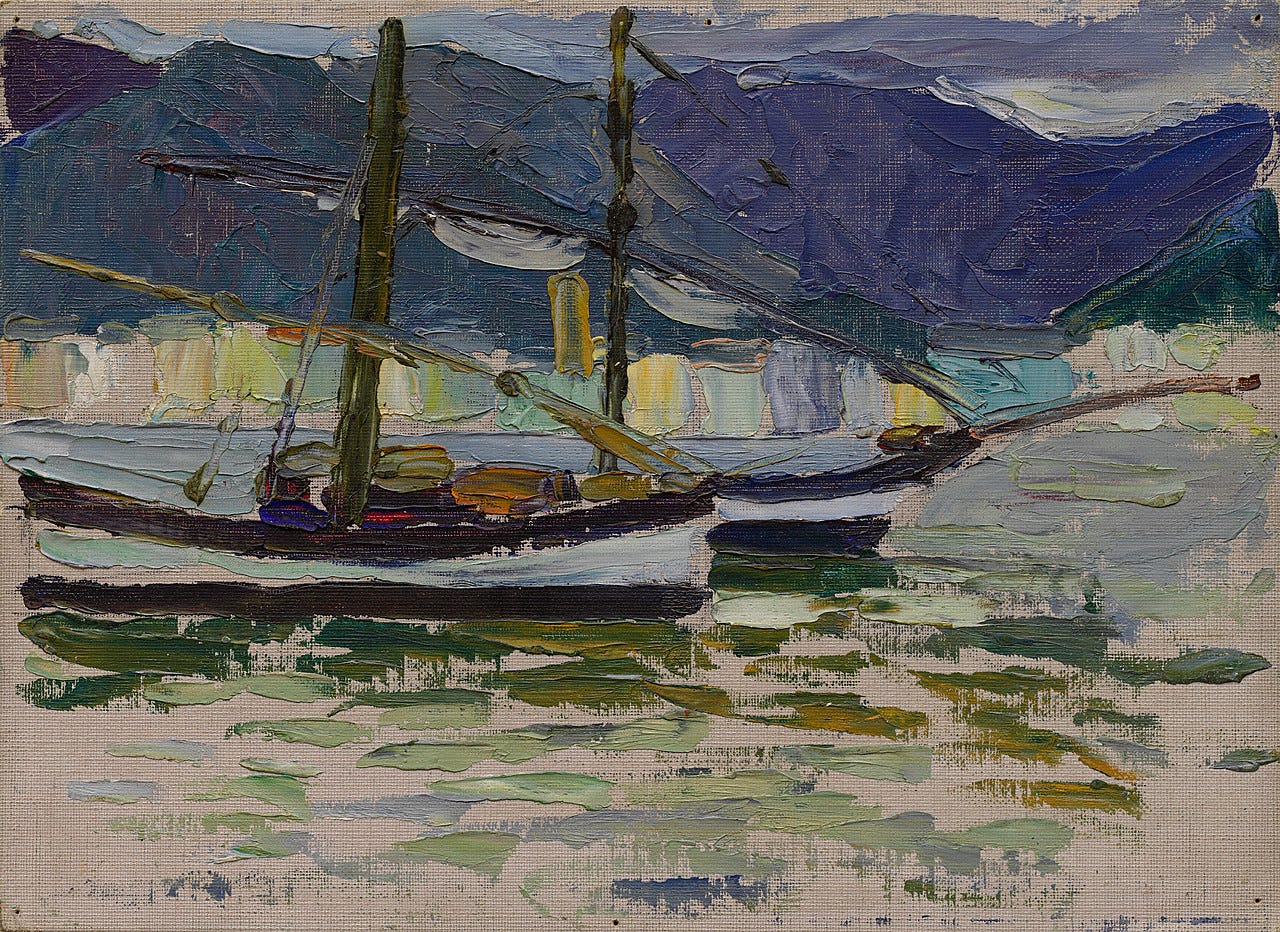
“This one,” Lys murmured. “This is where it starts.”
“Starts what?”
“The shift. From representation to resonance.”
“Ah,” Dellen said. “Synesthesia, yes?”
“Exactly. For him, color and sound weren’t separate. Moving away from figuration wasn’t about escape, it was about rendering the world more honestly, more subjectively.”
“How intriguing to hear you place honesty and subjectivity side by side.”
Lys smiled faintly. “You sound surprised. You of all people should know truth depends on perspective.”
“Kant would disagree,” Dellen countered. “He posited that objective truth exists but is beyond our grasp: we can know the world only as it appears to us. That’s not honesty, that’s limitation.”
“Then maybe that’s where honesty begins,” she noted, “in confronting how little of ourselves and our surroundings we control.”
He tilted his head, amused. “A very Kierkegaardian notion. Despair as sincerity.”
“Or as awareness. The artist’s despair, maybe…realizing you can’t paint the thing itself, only how it feels to see it.”
His eyes flicked toward her. “And what about you, Lys? When you perform, are you painting what is, or how it feels?” His gaze felt more intense than before.
She gave a slow, knowing smile. “What’s the difference, if I make you believe it?”
Dellen hesitated, then conceded the point and turned back to the painting. “So this is the visual equivalent of…chord changes?”
“That’s one way to look at it,” she said, her voice softening. “Or harmonic tension. A drone rising and falling around a tonal center.”
His smile curved, sly. “Sounds like foreplay with a metronome.”
Lys let out a sharp laugh, surprised despite herself. “You did not just say that.”
“I absolutely did. And I stand by it.” He cocked his head. “Think we could keep tempo like that? You and me?”
She gave him a bemused look. “Depends who’s conducting.”
Dellen bowed slightly. “Challenge accepted.”
They stopped before the next piece: Landscape with Rain, 1913. A storm rendered in fractured color—angular, kinetic, thrumming with the tension between chaos and rhythm. The composition surged and undulated like a musical phrase.
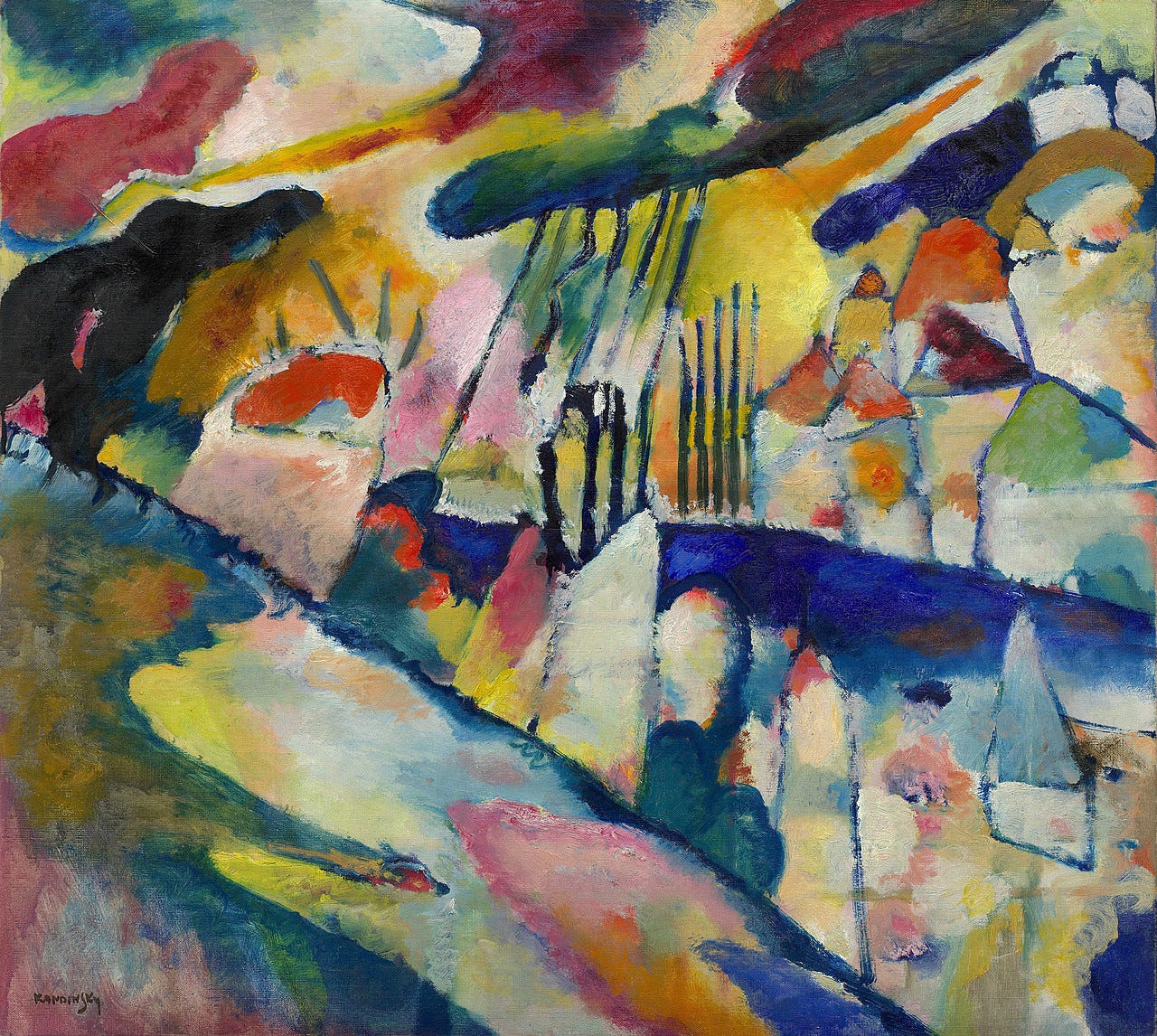
Dellen tilted his head. “You can almost feel the rain threading through the brushstrokes,” he murmured. “Reverberating through the canvas.”
Lys smiled. “There’s always music in his work. For him, a painting like this wasn’t just visual, it was symphonic.”
“Lucky bastard,” Dellen muttered. “Every shade, a sound. Every shape, a note.”
She nodded. “It’s what drew me to him. That merging of the senses. Art as experience, not message.”
Dellen’s voice dropped. “And rain like this…it’s not falling, it’s tasting. Moving like breath over a body, turning pigment into sound. It wants to know every curve, every hollow, until the whole world shivers beneath it.”
Lys glanced at him with a small, quizzical smile. His words brushed the edge of sensual, delivered with a softness that belied their heat. She said nothing. Just let it hang between them.
They moved to the next one: Blue Circle, 1922. The air seemed to still as they stood before it.
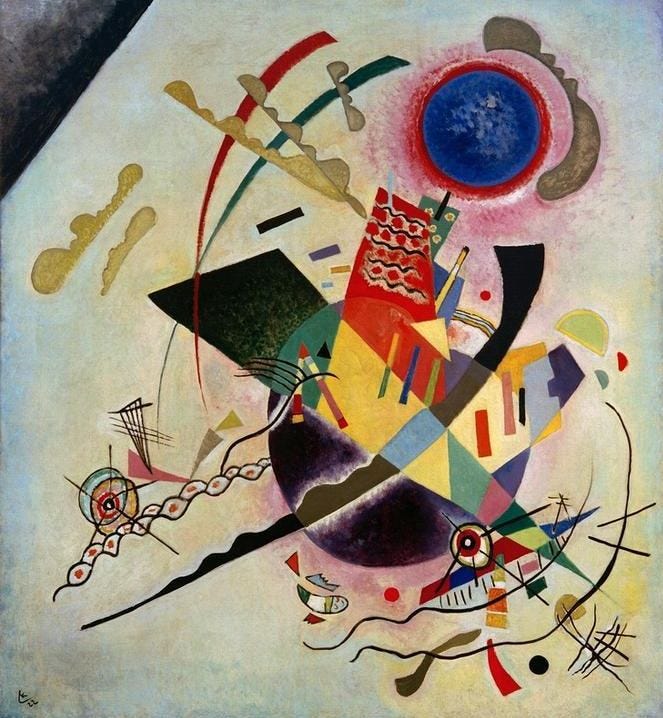
Dellen was quiet a long moment before speaking. “Balance and mystery. Discipline and seduction. It’s…mesmerizing.”
His tone had dropped, more reverent now. Their eyes met briefly, and she saw it again: that odd, haphazard alchemy in him tonight. As if something in his ordered world had toppled from its shelf and burst open, and now he was striding through the mess, each step conjuring a new chord, a quiet, radiant song rising from disorder.
She wanted to ask what it was, but instead said, “You’re not here just for me, are you?”
He looked at her, then smiled. Slow, restrained, undeniably fond.
“Tonight,” he said, “I’m here for the art.”
Dellen stepped closer to the painting, one hand in his pocket. “There’s something about circles,” he mused. “Closed, perfect, eternal. But this one doesn’t feel cold. It’s…inviting. Like a mouth waiting to be kissed.”
Lys raised a brow, lips twitching. “You’re dangerously close to mixing metaphors.”
He looked at her, deadpan. “Or maybe I’m just ravenous.”
“Ah,” she said, amused. “There it is, that famous appetite.”
“Hardly my fault. They say the palate sharpens with age. And I seem to have acquired a taste for something rare.”
“Careful, Dellen. Flattery only works if you don’t over-season it.”
“Trust me,” he said, leaning in slightly, voice velvet soft against her ear. “I’d never overpower this dish. Just savor it. Slowly.”
She scoffed, refusing to take the bait. “Spoken like a man who thinks he’s the only one holding a fork.”
They let the heat between their words fade as they turned back to the blue orb. It seemed to pulse with a silent moan, as if the canvas were absorbing their mirth and exhaling something slower and heavier, an ache rendered in color.
“This one…it doesn’t just want to be looked at. It wants to be understood. Entered.”
Lys tilted her head. “Are we still talking about the painting?”
He gave a lazy shrug, all innocence. The seriousness had begun to dissolve, leaving her a bit unsteady. It was like waltzing on a floor that wouldn’t stop tilting, paired with a partner who kept changing the steps.
They pivoted to the next painting, larger, louder, and more mathematically unruly than the rest: Composition No. 8, 1923. Geometry in ecstatic flight. Circles, triangles, arrows, lines of force colliding with elegance and precision. Controlled chaos…much like their conversation tonight.
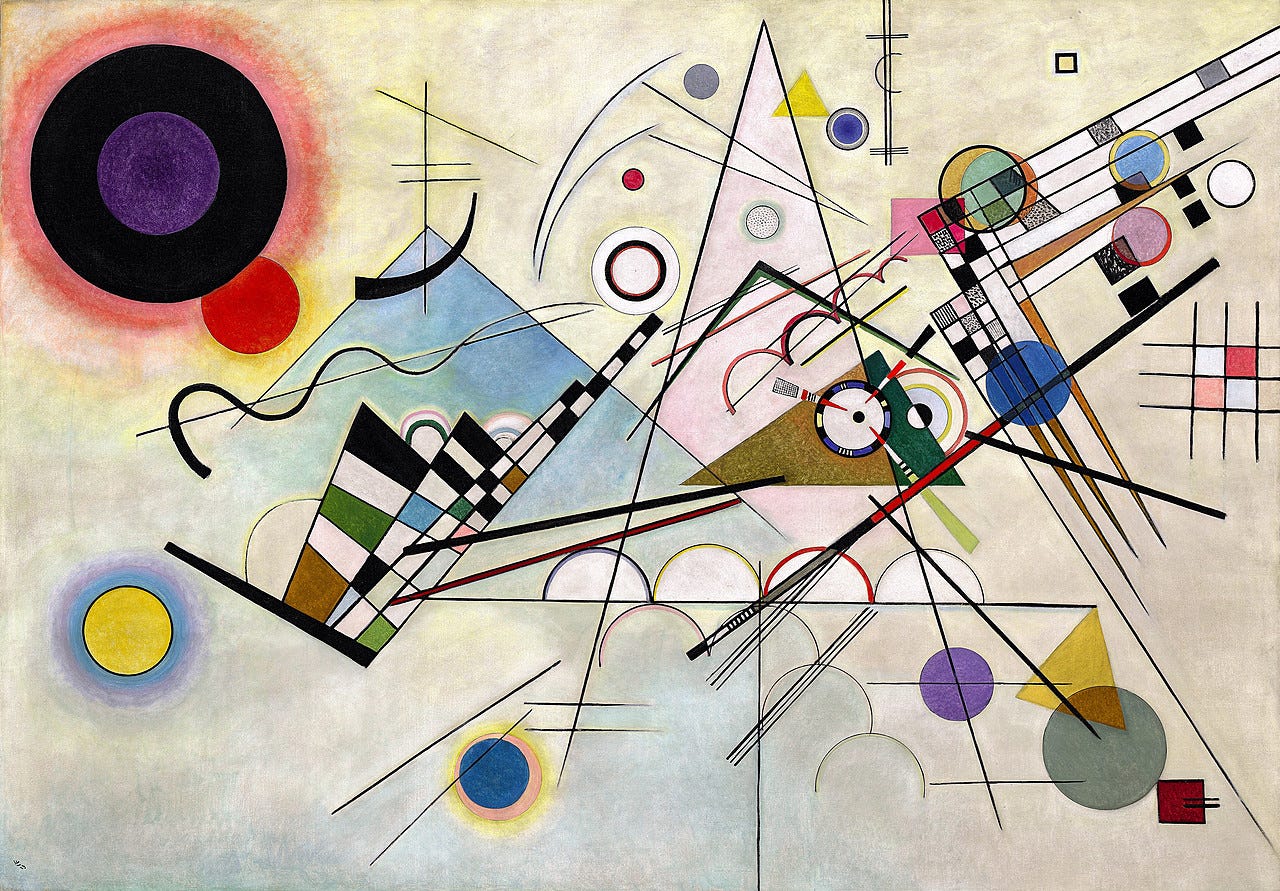
Lys stopped and inhaled, her body subtly shifting, as though she’d arrived at something sacred.
“This,” she said softly. “My favorite. Always has been.”
Dellen stood just behind, letting the silence bloom.
“I know it’s not the most emotional,” she continued. “But that’s what I love about it. It’s pure tension. Precision. Structure barely containing some tremendous, boisterous noise…like the 1812 Overture. Or Beethoven’s 9th.”
Her fingers twitched as if wanting to trace its logic. “Look how he balances the dark mass on the left with that burst of movement on the right. It shouldn’t work—it should collapse—but instead it feels like flight. Like he built a machine to defy gravity.”
Dellen smiled faintly. “Like you.”
“How do you mean?”
His voice dropped, low and steady. “You’re like this painting. Controlled. Intentional. Built from instinct and contradiction and sheer will. Every time I think I’ve mapped you, you change axis.”
He stepped closer. “But I don’t want to map you anymore. I just want to watch you move.”
Lys turned slowly to him. “Dellen…”
But his gaze held on the painting, like it anchored something rising in him.
“You said this one’s your favorite because it holds tension,” he murmured. “Because it feels like flight. That’s what it’s like to be near you, every time. You walk into a room and I feel it…this rising, this impossible geometry of want.”
Lys swallowed, her throat tight. “What—”
He turned toward her fully. His eyes weren’t mischievous anymore. They were open. Unmasked. Hungry not for play, but for her.
“I need you to know something,” he said, voice thick with restraint. “Something I’ve carried in silence, because saying it would change everything. But I can’t say it behind these masks. Behind these names.”
He whispered it like an invocation.
“Eva.”
The name broke across her like ice water. Not Lys, not the name of ritual. Her name.
Then his mouth was on hers. It felt warm, careful, but real. No games, no commands. Just a kiss. She pulled back with a sharp intake of breath, her eyes wide.
“I can’t,” she said.
His lips hovered, uncertain.
“I can’t do this.” Her voice was quiet but firm. “Not like this. Not when you’re…” She searched his face, something breaking behind her ribs. “This is real for you now, isn’t it?”
He didn’t answer. He didn’t need to.
“I’m sorry,” she whispered. “But I can’t be the thing you need to fill your life.”
She turned briskly and headed for the gallery exit.
Dellen stood rooted before Composition No. 8, feeling a terrible stillness settle in. The painting stared back, its geometry vibrating with tension, with flight, with everything she’d said…and everything he might lose.
“Eva—”
He spun around, her name cutting down the gallery like a crack of sound. She kept walking, head down, until his voice came again, louder now, trembling.
“My marriage is over.”
She froze.
For a heartbeat, the room held its breath. Then she turned, disbelief flickering across her face. He stood several yards away, chest heaving, hands half-raised.
“She served me three weeks ago,” he said, voice cracking. “Two days before our art critic scene. I thought we’d just stay separated: same apartment, different bedrooms, holidays together. It had worked for years. But she—” He stopped, swallowed. “She didn’t even tell me herself. Sent her brother instead. Made me pack, then kicked me out. I’ve been banished to the house in Greenwich, and I’m crashing with a friend in the city during the week, and it’s been one hell of an adjustment.”
He ran a hand through his hair, a short, strangled laugh escaping, devoid of humor.
“Dellen, I—” she began softly.
“Harold,” he cut in. “It’s Harold now. We’ve gone too far for pretense.”
Her lips parted, no words following.
“My daughter won’t speak to me,” he went on, raw, unraveling. “My son’s angry, feels caught between us. My friends—most were never really mine, just husbands of hers—and now they all but cross the street to avoid me. My practice feels hollow. My house—” He broke off, eyes bright. “It doesn’t feel like home anymore. Her toothbrush is still in the cup by the sink. I keep thinking if I throw it out, something terrible will happen.”
He stepped closer, breath ragged.
“I feel like my life’s coming apart stitch by stitch. Like I’m tied to the hood of a car careening off a cliff, and all I can do is watch the trees blur as I fall. You’re just about the only thing holding me together. When I’m with you, it’s like the world makes sense again, even if only for a little while.”
“Harold…” She stared at him, eyes shining, caught somewhere between pity and pain, unable to move.
He took one more step closer. “I don’t know what this is supposed to be. I just know that when I’m not with you, I can’t breathe right. And when I am with you, I start to believe I might actually survive this.”
Silence fell again. Behind him, Composition No. 8 seemed to vibrate faintly in the dim light, all that color and geometry suspended in perfect, impossible balance.
Eva couldn’t find her voice. Her heart hammered as she watched this man—no longer her Dom or scene partner, but something raw and human—unravel before her eyes. Every instinct screamed to run: to retreat down hushed corridors, to exit and let the city’s night air swallow her into anonymity. She could almost feel the pavement underfoot, the safety of motion, the relief of distance.
And yet her body betrayed her.
Somewhere beneath the torrent of his words, beneath the tremor in his voice and the raw edge of desperation, she felt it, that familiar echo. Not the expansive stillness he usually offered her in scene, nor the serene containment of a practiced Dom. This space was different. Misshapen. Cracked. Uneven and jagged in parts. But it was still space. And it was still his. And she was still who she was.
She stepped forward—slowly, silently—and wrapped her arms around him.
Harold froze. He’d braced for retreat: a turned back, a scolding voice, even rejection. But not this. Not grace. Not her presence, warm against his chest like it belonged.
She laid her head over his heart, and it was all he could do to remain upright.
He didn’t move, afraid to break the spell. But she stayed, so soft and real, and that steadiness undid him. His arms rose, tentative, then sure, and when she leaned in, a breath he hadn’t known he was holding escaped.
They stayed like that for a long time, the gallery dissolving into hush, its painted order fading into something quieter. Something only they could hear.
At last, she tilted her face up to his. His eyes shimmered, rimmed with unshed tears.
“I see you, Harold,” she said, voice low but steady. “Thank you for your gift of space.”
Her words were like a key in a lock. His breath shuddered, and tears slipped free.
“Thank you,” he whispered, voice fractured, “for filling it with your presence.”
She smiled, small and aching, then lowered her head once more to his chest.
This time his arms closed around her, sure and protective. He held her as if afraid she might dissolve if he let go. As if her weight were the only thing keeping him from disappearing.
Eventually, they pulled apart. Harold wiped his eyes with the back of his hand, gave a small, embarrassed laugh, and offered a tentative smile.
“Well,” he murmured, “that might be the most cathartic museum visit I’ve ever had.”
He reached for her hand and turned toward the exit, but she didn’t move. He felt the gentle resistance, that anchor of stillness, and turned back. Her expression had shifted, something bracing in the downturn of her brows. He let go of her hand and waited.
“I’m married.”
The words dropped like a stone. He stared at her, stunned. His lips parted, but no sound came.
“Happily,” she added, and it split something open in him.
Her voice was steady, but only just. “We’re in an open marriage. He has a partner—a metamour. I did too, until last year. We separated. I’m dating casually now. And of course…” she gestured between them, “I’m scening with you.”
She folded her hands neatly, composed, offering him the space to absorb it. His eyes dropped instinctively to her left hand.
She caught the glance. “My husband and I aren’t ring people. Never have been. Besides, rings complicate things in public. Not everyone’s open-minded about ethical non-monogamy.”
The words made sense, but they bounced off him like light on glass.
“I’m such an idiot,” he said finally, the words raw and brittle. “God. What a clusterfuck.”
“I’m sorry, Harold—”
“No,” he cut her off, shaking his head. “I’m the one who should be sorry. I unloaded all of that on you like a blithering dunce, and made some really asinine assumptions about what this was. What we were.”
“They weren’t asinine—”
“Yes,” he said sharply, “they were. I saw what I wanted to see. I built this intricate fantasy, and now I’ve probably ruined the one good thing I had left—”
“Harold—”
“—because I don’t know where the hell I’m going to find another scene partner like you. You’ve surpassed my wildest dreams, Lys…Eva, you really have—”
“Harold, please.”
He stopped, his breath coming in shallow bursts. She stepped closer and caught both of his hands in hers, holding them tightly.
“You’re under an enormous amount of strain right now. I understand. It’s natural to reach for something that feels good, something that anchors you. But you’re seeing things that may not actually be there.”
His face twisted with pain, but he didn’t look away.
“That doesn’t mean everything is lost,” she said. Her gaze flicked past him to the bold geometry and pulse of color on the wall behind him. Composition No. 8. Her sanctuary.
“I think we should take a break,” she said. “A few weeks. Let everything settle. Let you…process. Maybe talk to a therapist?” she added, with a gentle question in her tone.
A quiet, reluctant smile curled at the corner of his mouth. “Not a bad idea,” he admitted.
She squeezed his hands. “And then maybe, if it feels right, we can reconnect. See where we are.”
He looked at her for a long time, jaw tense, throat working. It wasn’t what he wanted. But it was mercy, more than he felt he deserved.
“Okay,” he said softly.
“Okay,” she echoed, reassuring.
She let go of his hands, and they stood for a moment, silent in the gentle echo of their own exhaustion.
Then she asked, “Should we finish?”
“Do you want to?”
She gave a small shrug. “I’d hate to come all this way and not get a selfie with my favorite painting ever, at least.”
He gave a surprised laugh, the sound frayed but real. “All right, fair enough.”
She fished her phone from her coat pocket and handed it to him. “You’re on photography duty.”
He activated the camera and stepped back as she positioned herself beside Composition No. 8. Her smile was casual but genuine. He took a few shots, centered and straight, then one at an angle that skewed the perspective, just to make her laugh.
When he handed the phone back, she flipped through them and nodded. “Thanks.”
“Don’t mention it.”
They kept going, not quite the same as before, but not broken either. The gallery stayed hushed around them, its high black walls holding the silence like a shell cupping light.
At the end, a final canvas stood alone: Far Away, 1930. A red orb hovered in a vast blue sky, glowing like a distant sun. Beneath it, a spindly white figure—a spire, or a tower, or perhaps something else entirely—rose from the ground like a question with no fixed language.
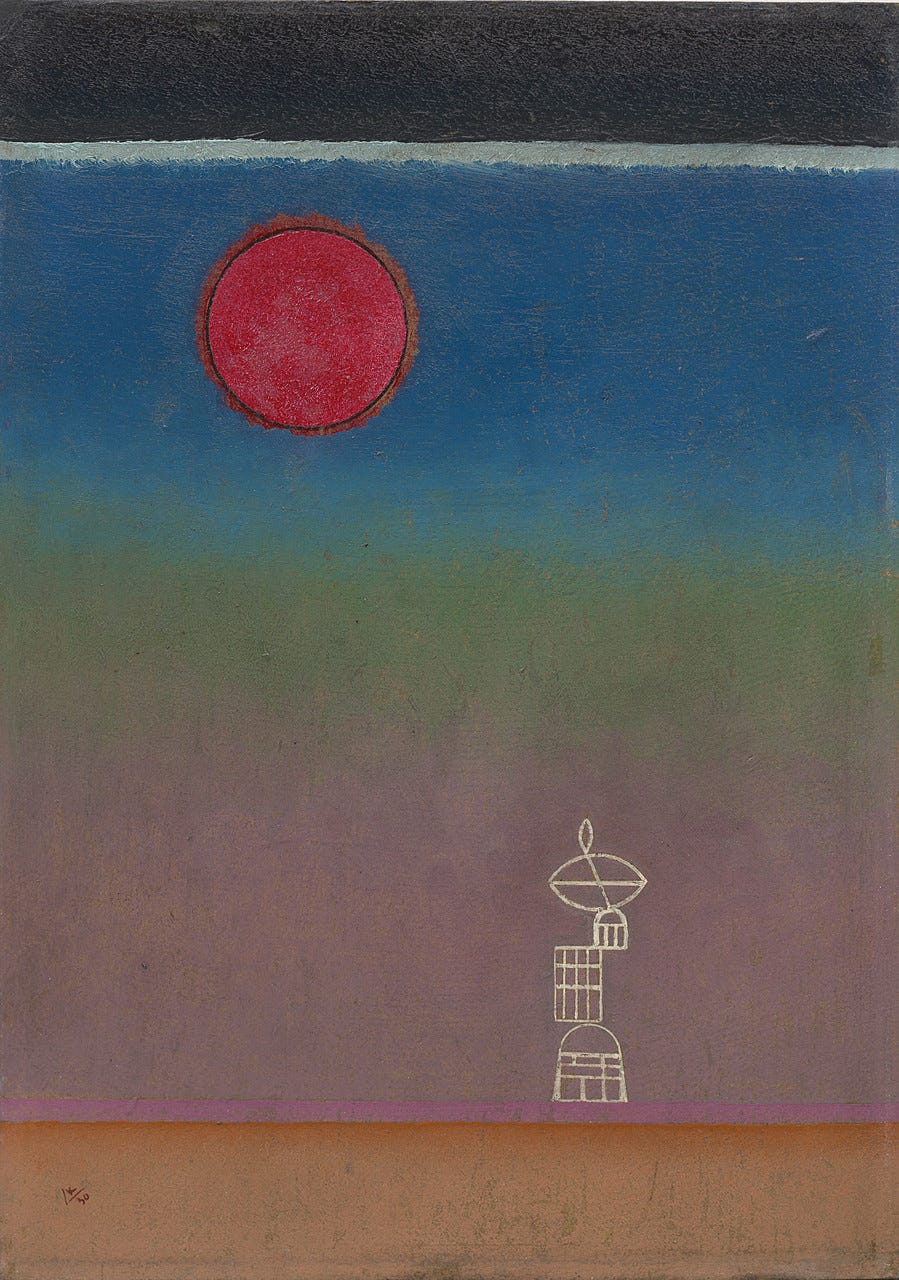
Harold tilted his head. “Is it a transmitter?” he asked. “Or a monument?”
Eva’s gaze stayed fixed on it. “Maybe both,” she said. “Or neither. Maybe it’s just…reaching.”
They fell silent again, the hush between them expanding to hold the weight of that thought. There was no resolution in the painting, only distance, tension, and a quiet kind of longing. But there was also space. And sometimes, space was what let things continue.
They stood like that for a while—two figures gazing into the far away, neither quite knowing what would come next.
I am in awe. What a chapter. The revelation and fantasy... Incredible writing thank you
There’s something profoundly tender in how you’ve written this, Demetria—
two people standing before art, and ending up as art themselves, suspended between revelation and restraint.
The way you let their masks fall without stripping away their dignity—
that felt deeply familiar.
It’s what happens when power stops performing and starts listening,
when desire finds its truth not in possession but in presence.
That red orb at the end, that unreachable distance—
it felt like the quiet pulse of every D/s bond that refuses to die,
because it has learned how to live in space instead.
Exquisite writing, Demetria.
You make honesty feel like art.
—Louis