
A Study In Contrasts
A private study in ambition, exposure, and the selves we keep in view.

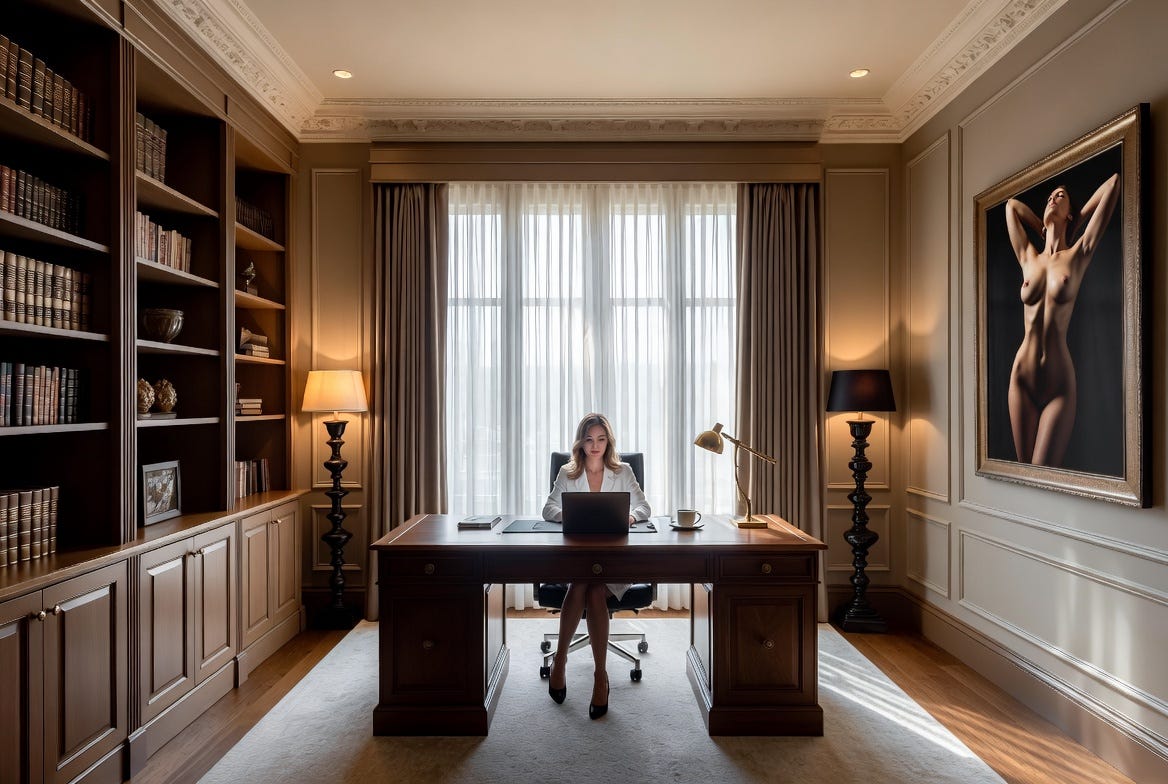
By six thirty, Evelyn had already made the bed, answered three emails from London, and stood barefoot on the heated limestone of her bathroom floor, studying her reflection with the clinical focus she usually reserved for quarterly forecasts. Her hair was wrapped in a towel, her face still bare, her skin damp from the shower. Outside, morning light spread across the windows of the house she had bought with stock grants, bonuses, and the brutal discipline of making herself indispensable.
The house was all pale stone, dark wood, linen upholstery, and tall panes of glass looking out over the canyon. Every vase and book, every low ceramic bowl on the console table had been chosen by a woman who knew how to make chic look effortless.
On the counter beside the sink, her phone buzzed.
Good morning. Show me.
The corners of Evelyn’s mouth rose before she could stop them. The smile softened her face, taking a good ten years off the director-level severity she had been practicing since her promotion six years ago. She glanced toward the bathroom door even though she was alone, then slid one hand beneath the robe she had not yet tied.
The lace was already damp.
She stepped back from the mirror, angled the phone downward, and took the photo exactly the way he preferred: no face, no coyness, only proof. The pale blue silk of the robe fell open at her hip. Her fingers held the edge of the lace aside just enough to satisfy. She took a quick glance at the outcome and pressed send before she could overthink it.
Then she set the phone down, picked up her moisturizer, and set about the rest of her morning routine. Serum, sunscreen, foundation, a trace of concealer beneath each eye. She would be giving a presentation at eight-thirty sharp to the executive team, and she intended to make them regret every quarter they had underestimated platform operations.
His reply came while she was applying mascara.
Good girl. No touching. Not today. I want you sharp.
Evelyn exhaled slowly, wand suspended near her lashes. The instruction invigorated her, like the tightening of a string only he knew how to pluck without ever breaking.
“Yes, Sir,” she murmured, though he was not there to hear it.
By seven fifteen, she had dressed in a charcoal knit sheath, gold studs, and a pair of pointed flats soft enough for the house but serious enough to keep her focused. She wore no bra because he had told her the night before not to. From the outside, she looked effortlessly polished, the kind of woman who made people take notice when she entered a room. Beneath the dress, her partially erect nipples pressed faintly against the fabric, a private humiliation invisible unless someone looked too closely. No one ever did, not on video calls, but she liked to imagine that they could. That was part of the thrill.
In the kitchen, she poured coffee into a porcelain cup and added half and half, watching the white ribbon unfurl through the dark surface. The consistency of it brought back a flash of his hand beneath her chin, his voice low and patient, his thumb at the corner of her mouth. She remembered kneeling for him, her mouth full of his cream, waiting until he gave permission before she was allowed to swallow.
The memory made her close her eyes for half a second—a brief moment of drift, not quite long enough to lose the morning. Just chasing the high of their the exquisite arrangement.
She drank the coffee standing at the marble island while scanning overnight metrics on her phone. Latency was stable, the customer-impact report was ugly but survivable, and Finance had already replied with objections to the headcount slide. Evelyn forwarded the message to her chief of staff with two clipped sentences and one attachment, then finished the coffee with a faint smile still on her mouth.
At seven forty, she walked down the hall to her office.
It was the most beautiful room in the house, though almost no one knew it. The door opened onto built-in walnut shelves, a cream wool rug, a long desk at one end facing the room, and a wall of windows looking into a grove of olive trees. It had the curated calm of an Architectural Digest photograph, if no one looked too carefully at what the silver frames on the desk actually held.
She ran one finger lightly along the edge of the nearest one, admiring the artistry, then sat down.
Her laptop woke as soon as she touched the trackpad. The calendar opened first: Executive Strategy Review — CEO, CTO, CIO, Board Observers. Below it were stacked prep meetings, follow-up sessions, and one discreet private event at nine that night labeled only Dinner.
Evelyn checked Slack. Her chief of staff had already cleaned up the Finance language. The CTO’s office wanted to know if she could cut two slides. The CEO had marked himself tentative for the first ten minutes, which meant he would appear at any moment and expect everyone to rearrange the conversation around him.
She breathed in through her nose and opened the deck. The title slide appeared on the monitor in clean blue type: Operational Resilience Roadmap: Q3–Q4 Execution Plan. She clicked through, testing the transitions, checking the appendices, verifying that every chart could withstand scrutiny. Her notes were precise, almost surgical, but beneath the movement of her hands lay the residue of his morning instruction. No touching. Not today. I want you sharp. The echo of his words gave all the restless, scattered hungers in her body a place to kneel so that the rest of her could stand.
A message appeared on her phone.
Wear the blue ring today.
Evelyn looked down at her right hand, where she had put on the narrow gold band she usually wore for important meetings. The blue ring was in the top drawer of her desk, tucked beneath a stack of financial forms. It was tastefully compact, almost severe: a sapphire set flush into brushed platinum, impossible to interpret unless one already knew its meaning.
She opened the drawer. Inside, beneath the documents, were other things no executive coach would have recommended. A folded silk blindfold. A strip of leather darkened with age. A small card in his handwriting that said, You are most powerful when you are not untouchable.
Evelyn removed the gold ring and replaced it with the sapphire. The metal was cool at first, then it warmed against her skin. She flexed her hand once, watched the blue catch the light, and returned to reviewing the deck.
At eight twenty, she stood to adjust the angle of the blinds. The morning had brightened too much, silvering the glass behind her monitor, and she needed the light softened before the meeting began. She reached for the cord, tilted the slats down a fraction, and from that angle caught the opposite side of the room in full.
Unlike the ones on her desk, these photographs were easier to ignore from her chair. That was part of the arrangement, part of his meticulous cruelty. She could work for hours with them at the edge of her awareness, their presence reduced to high contrast, silver frame, and dark gloss. But standing here, with the window at her back, she could not pretend they were merely décor.
The first was the one over the low cabinet: Evelyn bent over his lap, hair falling loose, one hand twisted helplessly in the edge of the rug while his palm rested against the back of her thigh. She was laughing in the photograph, though there were tears on her face. That one still embarrassed her, absurdly. Not because it was the most explicit—it wasn’t—but because joy had made her careless. Her mouth was open. Her face was unguarded. She looked, unmistakably, like a woman who had forgotten anyone might ever see her like this again.
She hid her eyes from that one first.
The black-and-white photograph beside it was different. That was the one that made her stand up straighter. In it, his hand was fisted in her hair with the absolute certainty of someone who had been given permission to hold what the rest of the world was never allowed to touch. Her throat was arched open to the camera. Her eyes were lowered. There was no softness, nothing performative in her expression. The first time she had seen it, she had expected to feel diminished. Instead, she had recognized discipline, and felt relieved by the recognition.
Then there was the triptych over the sideboard.
Even now, after months of living with it, that one made heat climb under her skin. Three narrow panels, all shadow and exposed skin, the composition too elegant to be obscene and too intimate to be anything else. In the left panel, two well-dressed men stood on either side of her, their faces cropped out, their bodies formal and composed while she knelt between them with rope crossing her bare shoulders. In the center panel, she was turned toward the camera, one cheek pressed to a polished shoe, her eyes lifted with an expression she still could not bear to look at directly for more than a second. In the final panel, his hand rested at the nape of her neck while the other man adjusted the line of rope at her hip, the gesture almost clinical in its precision.
It was not the nudity that made her flush. Nudity was easy. She had grown used to the sight of her own body rendered in shadow, in silk, in restraint. The obedience in her face, the extreme serenity—that was what still shocked her. There was no plainer evidence that she had wanted this arrangement, to be displayed and inspected, badly enough that the wanting had become visible.
She’d once asked him to take that one down. He had looked at her for a long moment, then kissed her temple, which was somehow worse than if he had frowned.
“No,” he had said. “That one still tells you the truth.”
Now, with the executive team waiting on her calendar and the CEO only a few minutes away from pretending his lateness was efficiency, Evelyn felt the same old blush move through her. It touched her throat first, then her cheeks. She hated it, and she loved it. The contradiction felt exactly like the hand closing around her neck in the last panel.
She released the blind cord and smoothed the front of her dress, even though it did not need smoothing. Then she returned to her chair with only a quick glance at the wall behind it.
That wall was pristine.
On camera, it showed only a demure painting of white lilies in a celadon vase, the brushwork soft and tasteful, the palette so restrained it bordered on apologetic. There were no photographs there, no evidence of the woman who had knelt on the rug beneath it two nights before while her Dom inspected her wetness and corrected the angle of her chin. To the executives and board members who would see her in a few minutes, Evelyn’s office would appear immaculate, almost conservative.
She checked the video preview. Dark hair smooth. Charcoal dress. White lilies in frame. Sapphire ring just visible when she lifted her hand to gesture meaningfully. The Director of Enterprise Platform Operations looked rested, controlled, and faintly formidable.
At eight twenty-five, the meeting room opened.
Faces began to populate the screen in small rectangles: CTO from a glass-walled conference room, CIO with coffee in a to-go cup, CFO looking already suspicious, two board members whose names Evelyn had memorized but whose expressions gave away nothing. The CEO’s square remained dark. Naturally.
“Morning,” someone said.
“Morning,” Evelyn replied, voice warm enough to be collegial, cool enough to remind them this was her room now.
She shared her screen and arranged her notes beside the deck. The first slide waited, clean and spotless, pretending that its current incarnation had emerged fully formed rather than survived twelve iterations and three separate pairs of hands. Around the edges of her monitor, the rest of the office remained visible only to her.
Then the CEO’s camera blinked on.
“Let’s get started,” he said. “Evelyn, I’ve got a hard stop in twenty. Give us the punchline first.”
For one breath, irritation flared with familiar intensity. Twenty minutes for two quarters of infrastructure risk, a staffing strategy, and a funding ask he had delayed twice. At the last second, she kicked off her flats and planted her bare feet on the floor, letting her thighs fall open instinctively. As she looked up from her notes, her gaze moved past the monitor to the far wall directly across from her.
There it was.
It was the largest photograph in the room, so large that there was no avoiding it once seen: a close-up of her face the first night he had taken her further than she had ever believed she could go. Mascara streaked grey-black down her cheeks. Crimson lipstick smeared across her mouth and chin. Drool glistened at the edge of the large ball gag strapped between her lips, and her eyes were wet, dazed, helpless, overflowing.
That session he had pushed her far past the clever, articulate self who could always negotiate one more inch of control. Once she crossed that threshold, once she stopped clinging to that last, fraying thread of composure, the world had opened into something vast and miraculous.
The first time she’d seen the image, she had cried tears of humiliation and joy.
Then he had said, Put it where you can see it when you are most afraid of being seen.
So she had hung it there, opposite her desk, where it could watch her through budget reviews, reorg conversations, performance calibrations, and every meeting in which mediocre men and women mistook her emotional opacity for incompetence. He had told her never to forget who she truly was. Not the mask, not the title, not the woman who had learned to survive by being invulnerable.
This, too, was her.
The woman in the photograph was messy, undone, and utterly beautiful. Evelyn thought it was the most honest and alive she had looked in her entire life.
The CEO cleared his throat. “Evelyn?”
Her face sprang into action, summoning the smile she deployed to reassure anxious higher-ups. Not the one she used to soften bad news or smooth the politics around a difficult ask. This was more compact, lined with a confidence no amount of imitation could manufacture.
“Of course,” she said.
She looked away from the photograph and back into the camera, where only flowers bloomed at her back, pristine and irreproachable.
“The punchline,” Evelyn said, “is that we are carrying enterprise-level risk on team-level funding, and we have been lucky longer than we have been prepared.”
The CFO’s eyebrows lifted. Good, she thought, as she advanced the slide.
“For the next twenty minutes, I’m going to show you what that luck has been costing us, what it will cost if we keep pretending it scales, and the three decisions this group needs to make before the end of the week.”
Her voice did not tremble. Her hands did not shake. Behind her, the lilies told their polite lie. Across the way, a ruined woman watched with tear-bright eyes and did not look away.
Mi piace il contrasto che tiene in piedi tutto il brano: Evelyn è impeccabile, controllata, quasi intoccabile davanti al mondo, e proprio quel controllo acquista più forza perché nasce da qualcosa di profondamente vulnerabile e vero. La doppia scena tra la freddezza della riunione e l’intimità privata funziona benissimo: elegante, tesa, e con quel senso costante che sotto la superficie perfetta ci sia sempre qualcosa che pulsa e non chiede permesso.
Oh I need to get a photoshoot like this done immediately